
Vertebroplasty
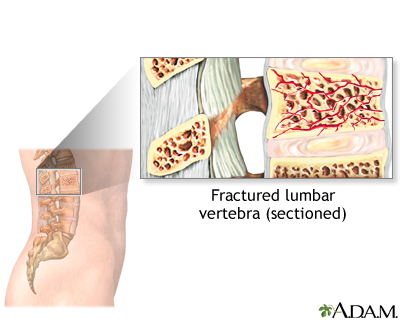
Osteoporosis - vertebroplastyVertebroplasty is often an outpatient procedure used to treat painful compression fractures in the spine. In a compression fracture, all or part of a spine bone collapses.
Compression fractures
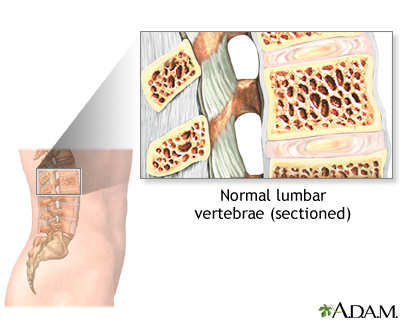
Compression fractures of the back are broken vertebrae. Vertebrae are the bones of the spine.

Description
Vertebroplasty is done in a hospital or outpatient surgery center.
- You may have local anesthesia (awake and unable to feel pain). You will likely also receive medicine to help you relax and feel sleepy.
- You may receive general anesthesia. You will be asleep and unable to feel pain.
You will lie face down on a table. The surgeon cleans the area of your back and applies medicine to numb the area.
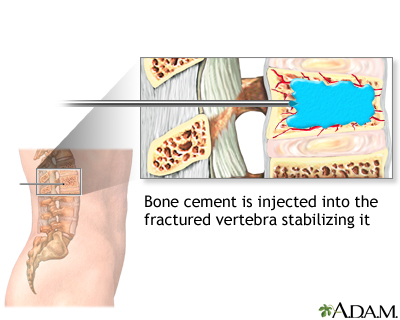
A needle is placed through the skin and into the spine bone. Real-time x-ray images are used to guide the surgeon to the correct area in your lower back.
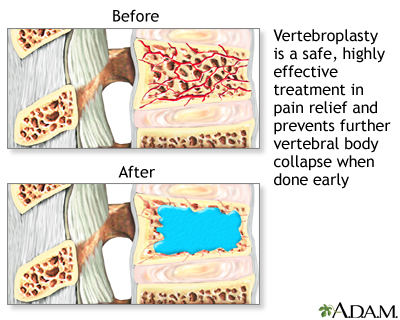
Cement is then injected into the broken spine bone to strengthen it and make sure it does not collapse again.
This procedure is similar to kyphoplasty. However, kyphoplasty involves the use of a balloon that is inflated at the end of the needle to create space between the vertebrae.
Kyphoplasty
Kyphoplasty is used to treat painful compression fractures in the spine. In a compression fracture, all or part of a spine bone collapses. The proc...
Read Article Now Book Mark ArticleWhy the Procedure Is Performed
A common cause of compression fractures of the spine is thinning of your bones, or osteoporosis. Your health care provider may recommend this procedure if you have severe and disabling pain for 2 months or more after a compression fracture that does not get better with bed rest, pain medicines, and physical therapy.
Your provider may also recommend this procedure if you have a painful compression fracture of the spine due to:
- Cancer, including multiple myeloma
Multiple myeloma
Multiple myeloma is a blood cancer that starts from a type of white blood cell in the bone marrow called plasma cells. Bone marrow is the soft, spon...
 ImageRead Article Now Book Mark Article
 - Injury that caused broken bones in the spine
Risks
Vertebroplasty is generally safe. Complications may include:
- Bleeding.
- Infection.
- Blood clots.
- Allergic reactions to medicines.
- Breathing or heart problems if you have general anesthesia.
- Nerve injuries.
- Leakage of the bone cement into surrounding areas (this can cause pain if it affects the spinal cord or nerves). This problem is more common with this procedure than kyphoplasty. You may need spine surgery to remove the leakage if it occurs. The leakage can uncommonly lead to more nerve injuries.
Before the Procedure
Always tell your surgeon:
- If you are or could be pregnant
- What medicines you are taking, including medicines, drugs, supplements, or herbs those you bought without a prescription
- If you have been drinking a lot of alcohol, more than 1 or 2 drinks a day
During the days before the surgery:
- You may be asked to stop taking aspirin, ibuprofen, naproxen, coumadin (Warfarin) , vitamin E, and any other medicines that make it hard for your blood to clot several days before.
- Ask which medicines you should still take on the day of the surgery.
- If you have diabetes, heart disease, or other medical conditions, your surgeon will ask you to see the provider who treats you for these conditions.
Diabetes
Diabetes is a long-term (chronic) disease in which the body cannot regulate the amount of sugar in the blood.
 ImageRead Article Now Book Mark Article
Heart disease
Coronary heart disease is a narrowing of the blood vessels that supply blood and oxygen to the heart. Coronary heart disease (CHD) is also called co...
 ImageRead Article Now Book Mark Article
 - If you smoke, try to stop. Ask your providers for help quitting smoking.
Quitting smoking
There are many ways to quit smoking. There are also resources to help you. Family members, friends, and co-workers may be supportive. But to be su...
 ImageRead Article Now Book Mark Article
 - Let your surgeon know about any illness you may have before this procedure. This includes COVID-19, a cold, flu, fever, herpes breakout, or other illness. If you do get sick, the procedure may need to be postponed.
COVID-19
Coronavirus disease 2019 (COVID-19) is a respiratory illness that causes fever, coughing, and shortness of breath, but many other symptoms can occur....
 ImageRead Article Now Book Mark Article
Cold
The common cold most often causes a runny nose, nasal congestion, and sneezing. You may also have a sore throat, cough, headache, or other symptoms....
 ImageRead Article Now Book Mark Article
Flu
The flu (influenza) is a viral respiratory illness that causes fever, chills, runny nose, body aches, and cough. It spreads easily from person to pe...
 ImageRead Article Now Book Mark Article
 - Ask your surgeon if you need to arrange to have someone drive you home after your surgery.
On the day of the surgery:
- You will most often be told not to drink or eat anything for several hours before surgery.
- Take the medicines your surgeon told you to take with a small sip of water.
- You will be told when to arrive.
After the Procedure
You will probably go home on the same day of surgery. You should not drive, unless your surgeon says it is OK.
After the procedure:
- You should be able to walk. However, it's best to stay in bed for the first 24 hours, except to use the bathroom.
- After 24 hours, slowly return to your regular activities.
- Avoid heavy lifting and strenuous activities for at least 6 weeks.
- Apply ice to the wound area if you have pain where the needle was inserted.
Outlook (Prognosis)
People who have this procedure often have less pain and a better quality of life after the surgery.
They most often need fewer pain medicines, and can move better than before.
References
Savage JW, Anderson PA. Osteoporotic spinal fractures. In: Browner BD, Jupiter JB, Krettek C, Anderson PA, eds. Skeletal Trauma: Basic Science, Management, and Reconstruction. 6th ed. Philadelphia, PA: Elsevier; 2020:chap 35.
Weber TJ. Osteoporosis. In: Goldman L, Cooney KA, eds. Goldman-Cecil Medicine. 27th ed. Philadelphia, PA: Elsevier; 2024:chap 225.
Williams KD. Fractures, dislocations, and fracture-dislocations of the spine. In: Azar FM, Beaty JH, eds. Campbell's Operative Orthopaedics. 14th ed. Philadelphia, PA: Elsevier; 2021:chap 41.
Review Date: 9/2/2025
Reviewed By: C. Benjamin Ma, MD, Professor, Chief, Sports Medicine and Shoulder Service, UCSF Department of Orthopaedic Surgery, San Francisco, CA. Also reviewed by David C. Dugdale, MD, Medical Director, Brenda Conaway, Editorial Director, and the A.D.A.M. Editorial team.
 All rights reserved.